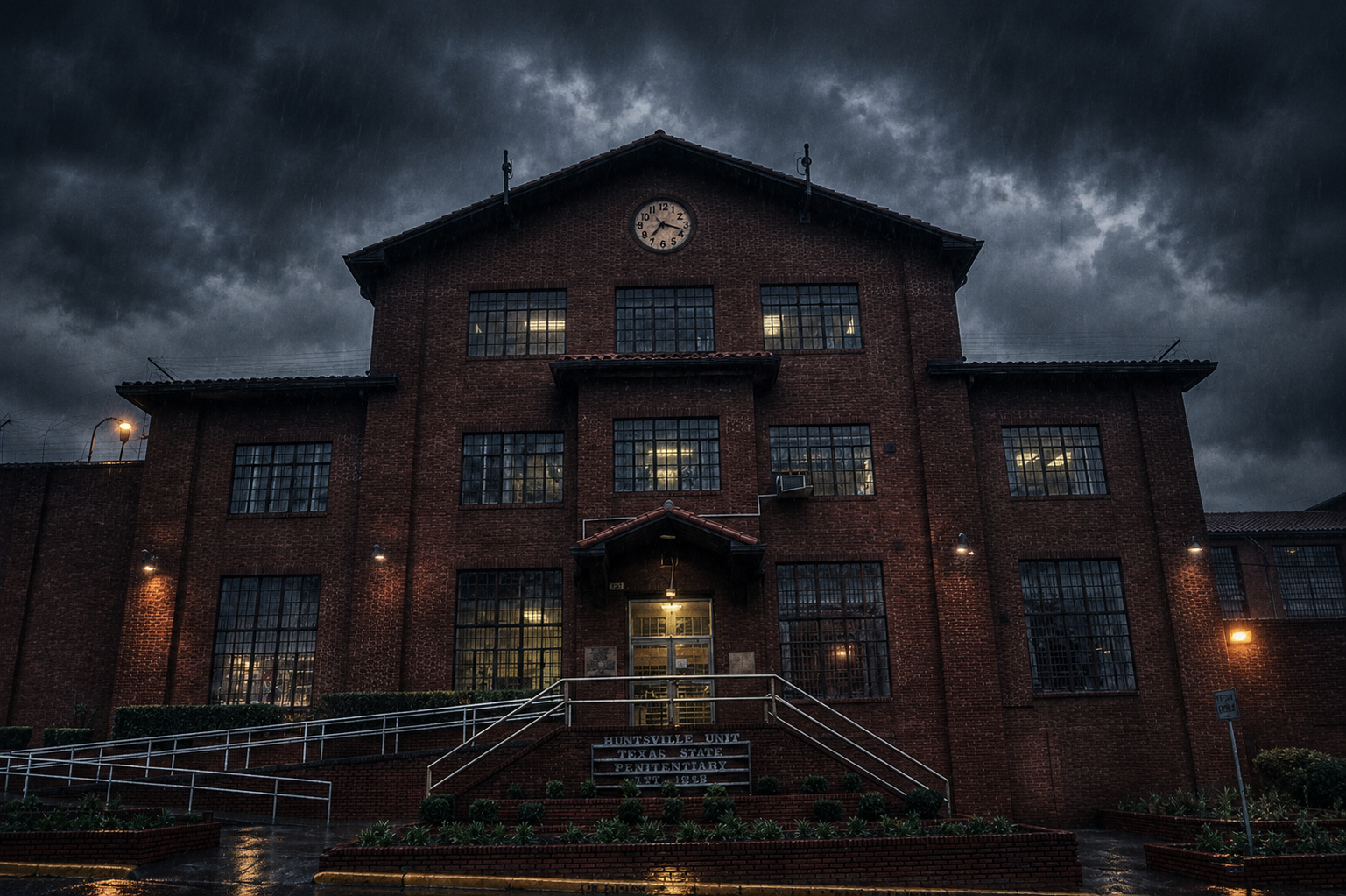
Texas executed Jamaal Howard last night. The state scheduled his death for 6:00 p.m. on Wednesday, October 7. His lawyers spent the day filing. The Texas Court of Criminal Appeals denied his last state appeal that morning. Two emergency petitions at the U.S. Supreme Court held the execution in place past the scheduled hour. Then the Court denied them without explanation. Justice Ketanji Brown Jackson was the only justice to publicly dissent. Howard was pronounced dead at 8:03 p.m. in Huntsville.
He was 46. He had been on death row since he was 21. He was the seventh person Texas executed this year and the 30th in the country.
Most of the country did not notice. A week earlier, Tennessee had tried to execute Christa Pike and failed. She survived two injections of pentobarbital and is now awake and speaking. The cameras went to Tennessee. Howard became the first person executed in the United States after that failure, with the same class of drug, and his name barely made the news.
The crime
On May 12, 2000, Howard, then 20, robbed a convenience store in Silsbee, north of Beaumont. He shot the clerk, Vickie Swartout, 42, once in the chest. He took $114 and a carton of cigarettes. Surveillance video captured the shooting. Vickie Swartout was a real person with a family who has lived with that loss for 26 years. Nothing in this essay is an argument that she did not matter.
Howard’s last words were an apology to her family. He told them he was sorry for what happened and hoped they could forgive him. He thanked his own family.
The question no court answered
The Supreme Court ruled in Atkins v. Virginia (2002) that the Constitution forbids executing people with intellectual disability. The question in Howard’s case was never whether he committed the crime. It was whether he was a person the state is allowed to execute at all.
The evidence was in the record from the beginning. Before trial, a court-appointed psychologist estimated his intellectual functioning at 65 to 70 and described him as functioning like a child of 11 or 12. At 17, three years before the crime, Howard had been shot in the head. In 2001, the state asked for juries to decide whether he was competent to stand trial. The first jury deadlocked. The second found him competent after his own lawyer did not call the defense expert to testify. His jury at trial never heard the IQ estimate as a number.
Here is what happened after that. On direct appeal in 2004, Texas’s highest criminal court rejected his intellectual disability claim using its own test, known as the Briseño factors. Those factors were written by a Texas court, not by doctors. The opinion that created them asked whether Texans would agree that Lennie, the character from Of Mice and Men, should be spared. A fictional man from a 1937 novel became the measuring stick for real people’s lives.
In 2012, Howard raised intellectual disability again in state habeas. The trial court held no evidentiary hearing. It signed the findings the state’s lawyers wrote, and the appeals court adopted them.
Five years later, in Moore v. Texas (2017), the Supreme Court threw out the Briseño factors. It said they had no grounding in medical science and created an unacceptable risk that people with intellectual disability would be executed. When Texas tried to reach the same result in Moore’s case anyway, the Supreme Court reversed it again in 2019.
Howard’s claim was decided under the test the Supreme Court rejected. No court ever went back and examined it under the correct standard. There was never an evidentiary hearing on his intellectual disability. There was never a hearing on whether he understood why Texas was executing him, which the Constitution also requires. Supporters, led by Rev. Dr. Jeff Hood, mailed coloring books to the court that could have ordered that hearing, because that is what Jamaal loved. It did not order one.
So was he intellectually disabled?
We don’t know, because there was never a hearing.
That is the honest answer, and it should disturb anyone who believes the death penalty is administered carefully. The state’s position at the end was that Howard had not proven he met the legal standard. But a person cannot prove anything to a court that will not hold a hearing. An evidentiary hearing is where claims like his get tested. Experts are cross-examined. Records are scrutinized. A judge looks at the person in front of them. That process was available. It was never used.
The drug
Howard’s lawyers also asked Gov. Greg Abbott for a 30-day delay. Texas uses compounded pentobarbital because manufacturers refuse to sell the drug for executions. The state extends the use dates on its supply when testing suggests the drug still works. Howard’s lawyers asked the state for information about the dose. Instead of answering, the prison system asked the attorney general whether it had to disclose anything, and that opinion was not due until after the execution date. They were not asking the governor to decide the case. They were asking him not to proceed with a drug Texas would not let them examine, days after the same type of drug failed in Tennessee. The governor did not respond.
The fact behind the fiction
Defenders of the death penalty often say it is reserved for the worst of the worst, after every question has been answered. Jamaal Howard’s case shows otherwise. The central constitutional question was decided under a test the Supreme Court later called unscientific, and it was never decided again. The state ran out the clock instead of answering it.
Texas will tell you justice was done last night. The record says something narrower: a sentence was carried out. Whether it was a lawful one, no one will ever know.
Sources: The Texas Tribune; CBS News; Fox News; Texas Department of Criminal Justice; Atkins v. Virginia, 536 U.S. 304 (2002); Ex parte Briseño, 135 S.W.3d 1 (Tex. Crim. App. 2004); Moore v. Texas, 581 U.S. 1 (2017) and 586 U.S. 133 (2019).
Leave a Reply